Understanding Semantic Relationships: A Key to Effective Communication
What are Semantic Relationships?
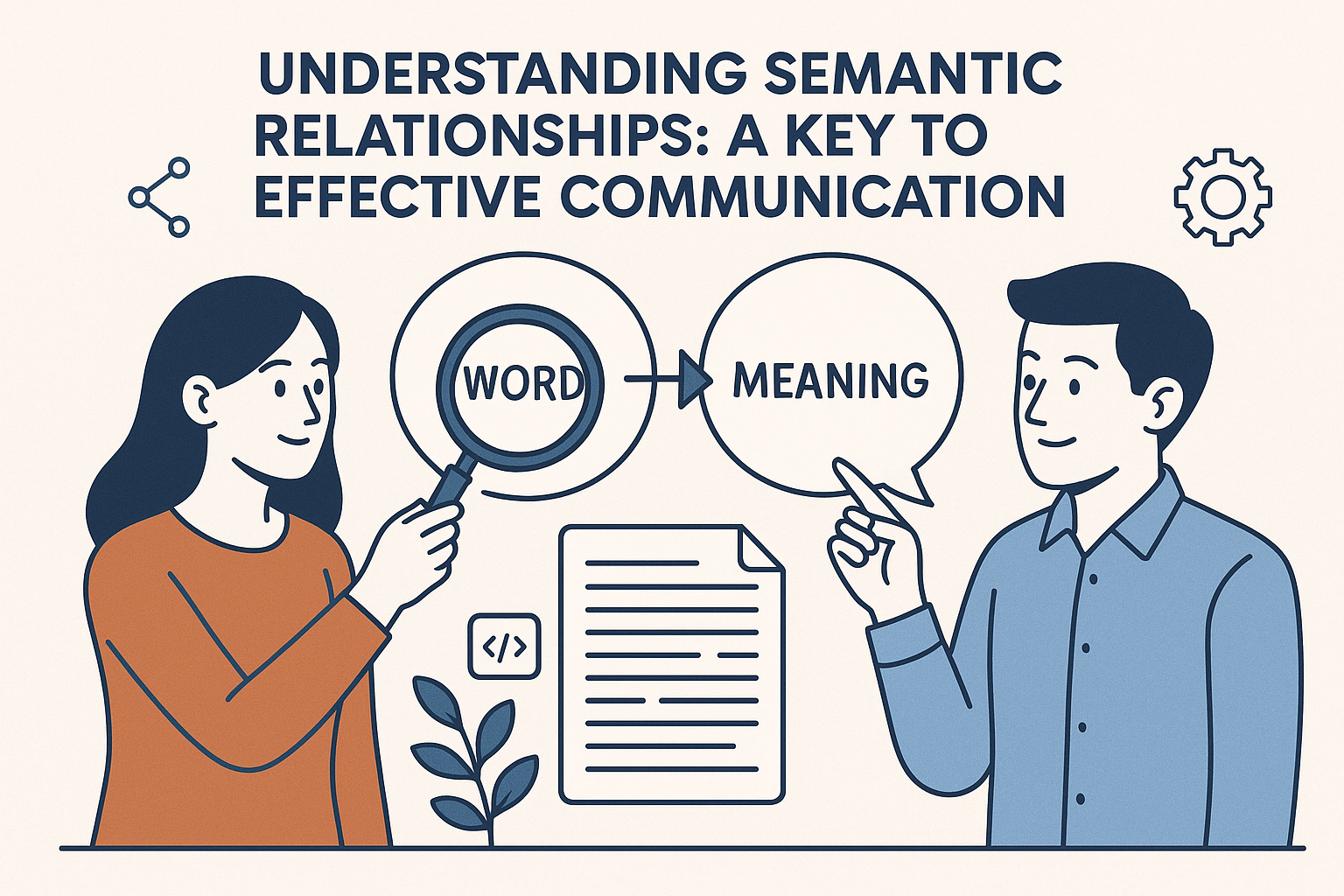
Semantic relationships refer to the connections between words and their meanings in language. They help us understand how different words relate to one another, forming the backbone of effective communication. These relationships can be categorized into various types, including synonyms, antonyms, hyponyms, and hypernyms. Understanding these relationships enhances vocabulary and improves comprehension, making it essential for both language learners and native speakers. In the digital age, understanding semantic relationships is also crucial for navigating search engines and digital communication platforms. Read: Understanding Technology Digital Literacy: A Comprehensive Guide. Read: Exploring Various Software Applications: A Comprehensive Guide. Read: Exploring Effective Sex Techniques for Men’s Sexual Wellness.

Types of Semantic Relationships
1. Synonyms: Words that have similar meanings, such as ‘happy’ and ‘joyful’, help enrich language and provide nuance in expression. For more details, see Brand Lexicon Validation in Men’s Sexual. For more details, see Brand Lexicon Validation: Making Men’s Sexual.
2. Antonyms: Words that have opposite meanings, like ‘hot’ and ‘cold’, create contrast and clarity in communication.

3. Hyponyms: Specific terms that fall under a broader category, such as ‘rose’ being a hyponym of ‘flower’, allow for precise descriptions. For more details, see explore the benefits of vector databases.
4. Hypernyms: General terms that encompass a group of related words, like ‘vehicle’ for ‘car’, ‘truck’, and ‘bicycle’, help in organizing knowledge. Understanding these types of semantic relationships is crucial for effective writing and speaking.
The Importance of Semantic Relationships in Communication
Semantic relationships play a vital role in effective communication. They help convey meaning clearly and accurately, reducing ambiguity in language. For instance, using synonyms can enhance writing style, while antonyms can clarify arguments. In educational settings, teaching semantic relationships aids vocabulary development and comprehension skills. Furthermore, understanding these relationships is essential for language processing in artificial intelligence, as it allows machines to interpret human language more effectively. This understanding is also pivotal in fields like social science and computer science, where language and data interpretation are key.
Applications of Semantic Relationships in Various Fields
Semantic relationships have far-reaching applications across different domains:
1. Linguistics: Linguists study semantic relationships to understand language structure and meaning. For more details, see Mastering SEO-Optimized HTML Post Structure.
2. Artificial Intelligence: In AI, semantic relationships are crucial for natural language processing (NLP), enabling machines to understand context and intent in human communication.
3. Education: Educators employ semantic relationships to enhance vocabulary instruction and reading comprehension strategies, helping students grasp complex texts. This is particularly useful in subjects like English and history, where understanding context and nuance is important.
4. Marketing: Marketers use semantic relationships to analyze consumer language and improve targeting strategies in advertising, ensuring messages resonate with audiences.
How to Enhance Your Understanding of Semantic Relationships
Improving your grasp of semantic relationships can significantly enhance your communication skills. Here are some effective strategies:
1. Read Widely: Exposure to diverse texts helps you encounter various semantic relationships in context.
2. Use Thesauruses: Tools like thesauruses can help you discover synonyms and antonyms, expanding your vocabulary.
3. Practice Writing: Regular writing exercises that focus on using different types of semantic relationships can solidify your understanding.
4. Engage in Discussions: Participating in conversations allows you to practice using semantic relationships in real-time, reinforcing your skills.
5. Utilize Online Resources: Many online platforms offer interactive tools and games to help understand semantic relationships, which can be particularly beneficial for students preparing for exams.
Intro to Semantics and Pragmatics Review
Understanding the distinction between semantics and pragmatics is crucial in grasping the full scope of semantic relationships. Semantics deals with the meaning of words and phrases in isolation, while pragmatics considers context and the intended meaning behind communication. This dual approach helps in decoding complex language structures and enhances comprehension.
5 Must Know Facts For Your Next Test
1. Semantic relationships are foundational in language learning and development.
2. They are essential for effective communication and reducing ambiguity.
3. Understanding semantic relationships aids in artificial intelligence and machine learning.
4. They have practical applications in marketing, education, and linguistics.
5. Mastery of semantic relationships can improve both written and spoken language skills.
Review Questions
1. What are the four main types of semantic relationships?
2. How do semantic relationships enhance communication?
3. Why are semantic relationships important in artificial intelligence?
4. How can educators use semantic relationships to improve learning?
Related Terms
Understanding semantic relationships involves familiarity with related terms such as syntax, morphology, and phonology. These linguistic components work together to form the structure and meaning of language, providing a comprehensive framework for language analysis.
Articulation / Phonological Process Virtual Games, Materials, & Activities
Interactive games and activities can be valuable tools for understanding semantic relationships. These resources help reinforce learning through practical application and engagement, making complex concepts more accessible to learners of all ages.
Language Virtual Games, Materials, & Activities
Virtual games and materials designed to teach language concepts often incorporate semantic relationships to enhance learning. These tools provide interactive and engaging ways to explore language, making them ideal for both classroom and independent study.
Understanding Semantic Relationships in Speech and Language Development
In speech and language development, semantic relationships are crucial for building vocabulary and comprehension. Children learn to associate words with meanings and contexts, which forms the basis for effective communication and literacy skills.




Post Comment