How We Test and Recommend Men’s Sexual Wellness Gear
Overview
You deserve clear, evidence-based guidance in mens sexual wellness. DickCanGrow’s testing program is built to cut through marketing claims and show you precisely why we recommend a jelq lubricant, a penis extender or penis stretcher, a sex technique curriculum, or an ejaculation control tool—and when we don’t. We run repeatable bench tests, real-world wear-time evaluations across diverse body types, and a rigorous safety gate rooted in medical standards. We are affiliate-supported. If you buy through our links, we may earn a commission. Our editorial standards, test design, and scoring are independent and published. No brand can buy a score or a spot. Read: Affiliate Test, Upgraded: Home Mini‑Trials That Validate Men’s Sexual Wellness Claims. Read: Affiliate Test Scorecard: A 10‑Minute Buyer’s Audit for Men’s Sexual Wellness Offers. Read: The Affiliate Test: Fact‑Checking Men’s Sexual Wellness Claims Before You Buy. Read: The Physiology Stack: Jelq, Extenders, and Ejaculation Control—An Integrated Guide for Men’s Sexual Wellness.

Why a Science-Backed Protocol Matters and What We Cover
Men’s sexual wellness is noisy: contradictory forum advice, inflated promises, and devices that look similar but perform differently. A science-backed protocol ensures three things. First, you see the safety bar every product must clear. Second, you understand what the evidence says—and doesn’t—about traction, jelqing, arousal control, and ejaculation delay. Third, you can map scores to your goals: length, curvature support, sensation tuning, or stamina. For more details, see The Affiliate Test, Controlled: N-of-1 Protocols. For more details, see The Men’s Sexual Wellness Toolkit: Accessories.
What’s in scope
– Devices: penis extender frames, rods, vacuum chambers and sleeves, straps/nooses, base rings, and supporting parts marketed as penis stretcher systems.
– Accessories: jelq lubricants, grips, sleeves, glides, and aftercare balms.
– Training and content: stepwise sex techniques and arousal-control programs, pelvic floor coaching, and partner-focused methods.
– Ejaculation control tools: delay sprays, condoms, and training apps that target intravaginal ejaculation latency time.
What’s not in scope
– Surgery, prescription drugs, or hormonal therapy.
– Illicit or unregulated injectable substances.
– Devices without basic documentation on materials or quality systems.
Where this page fits with our how-to library
– We don’t re-teach extender setup, tension ramping, or routines you’ll find in Extender Comfort: Daily Setup Without Pain or Slippage, Neutral Setup: Extender Fit That Holds Without Slipping, Extender Signals: When to Stop, When to Increase, or Beginner-Friendly Daily Stretching Routine. This page explains the backbone of how we test, score, and keep reviews current across mens sexual wellness categories.
Safety Gate and Evidence Hierarchy
Every device or product faces a pass/fail safety gate before any performance testing.
Safety gate checklist we enforce
– Materials: We look for documentation aligned with ISO 10993 biocompatibility and, where relevant, USP Class VI for polymers contacting skin or mucosa. We flag non-compliant or unknown materials.
– Quality system: Preference to manufacturers operating under ISO 13485. We review traceability, labeling, and basic instructions for use.
– Chemical and allergen risk: REACH/RoHS declarations, phthalate-free claims, latex disclosure, and silicone grade. We scrutinize adhesives for vacuum sleeves and tape for potential sensitizers.
– Mechanical integrity: Rod thread quality, base ring finishing, vacuum chamber edge radius, strap/noose elasticity consistency, and chamber/sleeve pressure loss under load.
– Contraindications: We check whether the brand clearly communicates who should not use the device or product and under what conditions.
Our evidence hierarchy
– Tier 1: Peer-reviewed clinical trials and systematic reviews on traction therapy, curvature support, and ejaculation delay interventions. See Do Penis Extenders Really Work? Research Evidence, Average Gains, and How Long It Takes; Penis Traction Therapy for Peyronie’s Disease: Evidence-Based Protocols; Does Jelqing Work? Research Evidence, Risks, and Realistic Expectations.
– Tier 2: Lab or bench data from manufacturers that we can reproduce or validate.
– Tier 3: Aggregated user data from our panel and long-term readers, gathered through standardized logs.
– Tier 4: Expert consensus and mechanism-based reasoning from sexual medicine, biomechanics, dermatology, and pelvic floor physio.
We weight Tier 1 the highest. Where Tier 1 is thin (e.g., jelq-specific outcomes), we lean on Tier 2–4 but mark confidence accordingly.
How We Test Extenders and Stretchers: Bench and Wear-Time
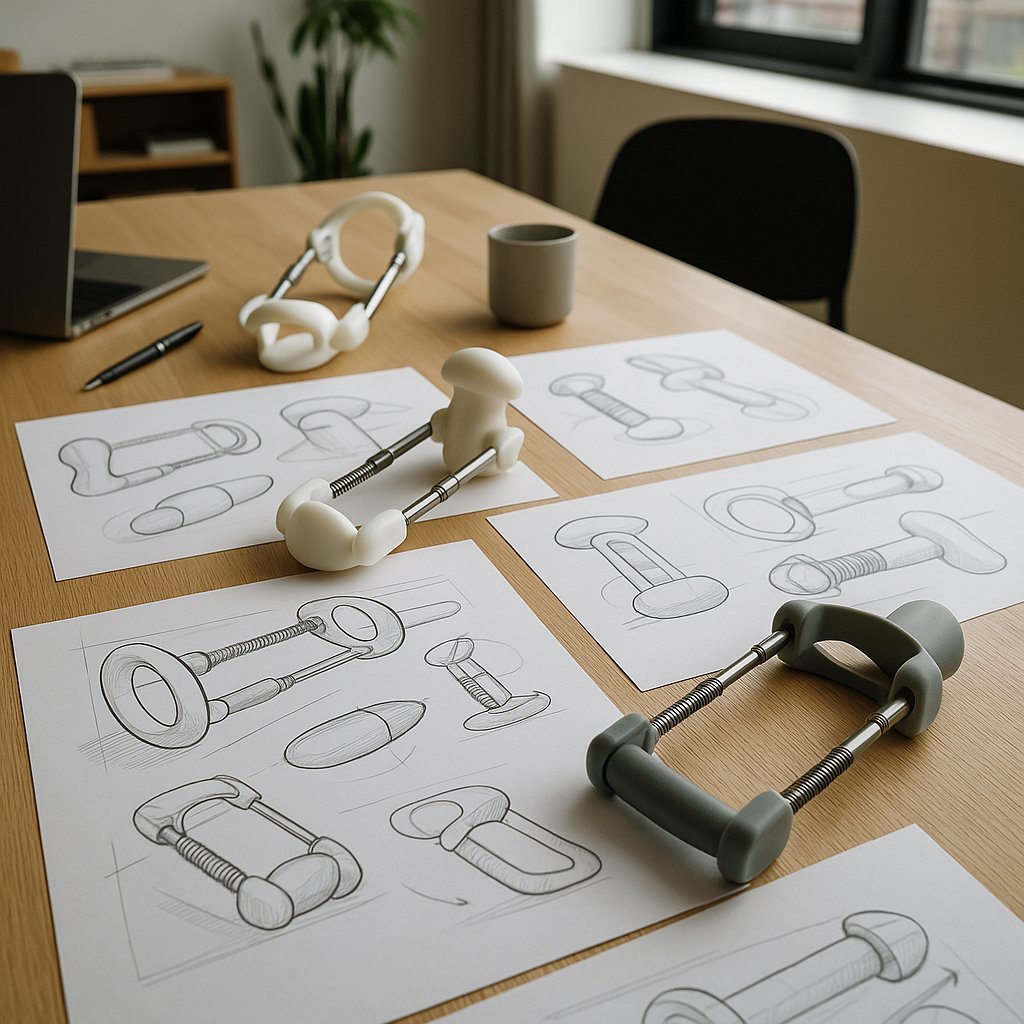
Penis extender and penis stretcher systems look similar on product pages yet can differ dramatically in tension accuracy, slippage resistance, and skin response. We test both vacuum and strap/noose platforms side-by-side. For background on platform tradeoffs, see Vacuum vs Strap/Noose Penis Extenders: Safety, Comfort, Results, and How to Choose.
Test panel design
– Body types: We recruit across short/average/long bone-pressed length and narrow/average/wide girth. Circumcised and uncircumcised representation matters because clamp and sleeve behavior change with anatomy.
– Sizing: We verify that each panelist uses correctly sized base rings, rods, sleeves, and straps as per the brand’s guidance. We document any need for aftermarket parts.
– Baselines: We record BPEL (bone-pressed erect length), NBPEL, mid-shaft EG (erect girth), flaccid stretched length, and curvature angle where applicable. We also log skin sensitivity and prior device experience.
Bench tests
– Tension calibration: We use inline load cells to measure actual traction at the carrier spring indicators and across rod extensions. We map target vs delivered traction from 300 g to 1,200 g or the device’s rated range and note error margins.
– Slippage resistance: For strap/noose systems, we test clamp pressure vs slippage by incrementally loading until the first millimeter of distal movement. For vacuum systems, we measure time-to-leak under static loads and the number of don/doff cycles to sleeve failure.
– Build quality: We inspect threads, rod straightness, finish quality of base rings, and chamber-edge radii that contact skin. We test cleaning durability with soap, alcohol wipes, and recommended disinfection.
– Compatibility: We verify whether third-party sleeves, straps, and comfort parts fit without compromising safety.
Wear-time evaluations
– Comfort and skin response: Panelists log 60–120 minute sessions, noting pressure points, edema patterns, glans discoloration, and thermal changes. We require cooldown intervals between blocks and record recovery markers.
– Usability: We score don/doff time, discrete wear under clothing, adjustment stability during movement, and the frequency of mid-session re-seating.
– Real-world signals: We document when panelists must stop, when tension increases feel sustainable, and how devices behave during longer blocks. For practical cues, see Extender Signals: When to Stop, When to Increase and Extender Comfort: Daily Setup Without Pain or Slippage.
We do not coach routines inside product tests. For technique and daily structure, see Neutral Setup: Extender Fit That Holds Without Slipping and Beginner Extender Routine articles.
How We Test Jelq Support, Sex Technique Content, and Ejaculation Tools
Jelq support products
– Lubricants: We measure viscosity, glide time, tackiness, pH, and osmolality where relevant for skin health. We screen ingredient lists for potential irritants and fragrance allergens. We test clean-up and compatibility with sleeves and latex.
– Grips and sleeves: We assess friction consistency under varying pressure, ease of positioning, and durability across 50+ cycles. Aftercare balms are checked for occlusivity and soothing efficacy without clogging pores.
– Skin outcomes: Panelists log redness, burning, micro-abrasions, and recovery time. Products causing repeat irritation fail regardless of performance.
Sex technique content
– Curriculum integrity: We review arousal control frameworks, pelvic floor cues, breath pacing, and partner alignment steps. Content must progress from low-arousal drills to partnered practice with clear feedback loops, not vague tips.
– Evidence anchors: We cross-check against sexual psychophysiology research (arousal thresholds, sympathetic/parasympathetic balance, Kegel vs reverse-Kegel cues). We reject content that confuses edging with chronic clenching.
– Practicality: We score clarity, session length, homework structure, and partner communication scripts. We test whether exercises translate into better control for beginners and intermediates.
– Language clarity: We flag programs that overpromise outcomes or that rely on mystical claims. Our review notes include the exact timelines they advertise.
– Intentional keyword note: We evaluate “sex techniq” content the same way—by structure, evidence grounding, and measurable practice outcomes.
Ejaculation control tools
– Delay sprays: We verify active concentrations (commonly lidocaine/prilocaine), onset time, absorption, transfer risk, and effect on sensitivity. We collect before/after IELT logs and side-effect reports (numbness, partner feedback).
– Condoms: We test thickness, lubrication type, and friction feel during use, then link outcomes to control and sensation. We note fit range and the real-world risk of slippage or breakage.
– Training apps: We check session design, pelvic floor cueing accuracy, tracking features, privacy terms, and whether reported IELT gains persist at one and three months.
For related deep dives, see Ejaculation Control While Using a Penis Extender: A Practical 6‑Week Routine and How to Increase Semen Volume Safely: Evidence‑Based Strategies, Supplements, and Myths.
Scoring, Data Integrity, Red Flags, and How to Use Our Results
Our scoring rubric balances safety, evidence, and day-to-day usability. We publish category-specific weights in each review, and we summarize them here for transparency.
Core scoring dimensions
– Safety and materials (30%): Biocompatibility documentation, chemical risk, mechanical finishing, and clarity of contraindications.
– Evidence and mechanism (20%): Alignment with clinical data or well-reasoned mechanisms when direct evidence is limited.
– Usability and comfort (20%): Don/doff time, stability, skin response, and learning curve.
– Performance (15%): Tension accuracy and slippage resistance for devices; glide metrics for lubes; latency gains for ejaculation tools; skill transfer for sex techniques.
– Support and warranty (10%): Customer service, parts availability, and warranty clarity.
– Cost and value (5%): Upfront price, required consumables, and long-term cost per month of use.
Data collection and repeatability
– Measurements: We standardize BPEL, NBPEL, EG, curvature angle, and IELT recording. Panelists follow the same diaries, and we audit entries for completeness.
– Privacy: We de-identify panel data, store it encrypted, and report only aggregated outcomes. Contributors can opt out at any time.
– Repeatability: Bench protocols are versioned; we re-run key tests when a product updates materials, hardware, or sizing.
Red flags we reject
– Claims of multiple inches of length in weeks or with overnight wear.
– “FDA approved” language for extenders; consumer traction devices are not approved for enlargement indications.
– Vague “micro-tears” marketing that ignores tissue adaptation realities.
– No material documentation, or obvious copycat frames with poor finishing.
– One-size-fits-all training promises in sex techniques and ejaculation programs.
Match scores to your goal
– Length-first: Favor high-accuracy traction, stable clamp/sleeve, and comfortable base rings. Cross-check with Do Penis Extenders Really Work? for realistic timelines.
– Curvature support: Look for devices with fine-grain tension control and reliable anchoring. See Penis Traction Therapy for Peyronie’s Disease for evidence-backed parameters.
– Sensation tuning: In condoms and lubes, prioritize friction feel and formulation that preserves arousal rather than numbing indiscriminately.
– Stamina and control: Pair structured arousal-control training with measured use of delay products, then taper as skill improves. See Ejaculation Control While Using a Penis Extender for a practical progression.
How we update reviews
– Versioning: Each review shows the test protocol version, product revision date, and change log.
– Re-testing: We re-test when materials, chambers, or straps change, when user reports shift, or annually for top picks.
– 2025 roadmap: Expanded load-cell mapping across more extender travel ranges, osmolality testing for additional jelq lubes, and longitudinal tracking of ejaculation training outcomes at 3–6 months.
Conclusion
Our job is simple: translate complex, sensitive topics into clear, actionable guidance grounded in evidence and repeatable testing. Whether you’re considering a penis extender or penis stretcher, dialing in jelq support, exploring sex techniques, or calibrating tools for ejaculation control, you should know exactly how and why we recommend what we do. This methodology is the backbone of every review we publish. Start with the goal that matters most to you, scan the scores, and dive into the linked deep dives to move forward with confidence.


Post Comment