Does Jelqing Work? Research Evidence, Risks, and Realistic Expectations (2025 Review)

Overview: The 2025 Bottom Line
Does jelqing work? For permanent length or girth gains, there’s no high-quality clinical evidence in 2025 to support it. The practice remains largely anecdotal, with self-reports ranging from “no change” to modest improvements and persistent stories of injuries. Some men report short-term plumping or better erection quality immediately after a session, but those effects are transient, not durable structural changes. Read: How to Increase Semen Volume Safely: Evidence‑Based Strategies, Supplements, and Myths (2025 Guide). Read: Penis Traction Therapy for Peyronie’s Disease: Evidence-Based Protocols, Expected Results, and Best Devices (2025 Guide). Read: Do Penis Extenders Really Work? Research Evidence, Average Gains, and How Long It Takes.
Where the evidence does exist—medical-grade traction via a penis extender or penis stretcher—results are more predictable for length, though still gradual and variable. Traction has published trials; jelqing does not. If your goal is measurable length change with the least uncertainty, traction therapy is the better-studied path. For more details, see Does Jelqing Work? Evidence-Based Answers,. For more details, see Does Jelqing Actually Work? Evidence, Risks, and. For more details, see Jelqing? Evidence-Based Facts, Myths, and Safer.
If you’re primarily focused on performance—erection quality, arousal control, ejaculation timing—jelqing isn’t a proven fix. There are more targeted, lower-risk approaches (pelvic floor training, arousal pacing, and behavioral techniques) with clearer mechanisms and better safety profiles. For more details, see the Benefits of Jelqing: Myths, Facts, and Results.

Bottom line: Jelqing’s benefits for size are unproven; risks are real; alternatives with evidence exist. If you proceed anyway, set conservative expectations, watch for warning signs, and measure properly so you’re not fooling yourself. For more details, see Everything You Need to Know About Jelqing:.
What Jelqing Is—and Where It Fits in Men’s Sexual Wellness
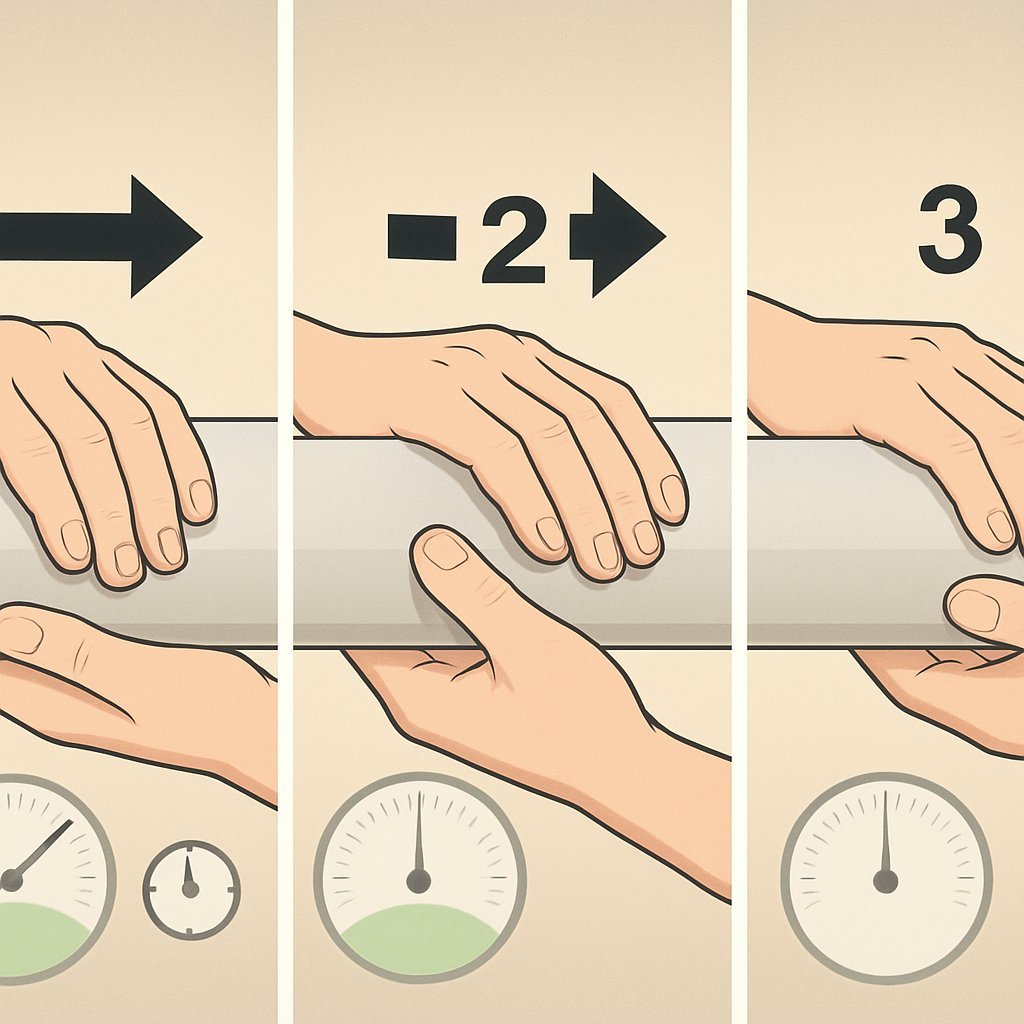
Jelqing refers to manual, milking-like strokes applied along the shaft at a partial erection with the goal of increasing size over time. It’s promoted heavily online as a sex techniq for growth, often bundled with routines that add stretching, edging, or pumping. Unlike traction therapy, jelqing relies on intermittent, user-controlled pressure rather than quantifiable, sustained low-load stretch.
Where it sits in mens sexual wellness: It’s a DIY method aimed at cosmetic length or girth, not a recognized medical treatment. It’s sometimes used by men seeking improved erection fullness or sensitivity, or as part of a broader experimentation period that includes lifestyle changes, Kegel training, or mindfulness around arousal and ejaculation. But those improvements are more plausibly explained by increased attention to sexual health and arousal patterns rather than structural changes from jelqing itself.
Key distinctions from traction:
– Control and dose: Traction devices deliver measurable, sustained force for known durations. Jelqing uses manual pressure with no objective dosing or standardized progression.
– Mechanism: Traction targets mechanotransduction of the tunica albuginea under low-load, long-duration conditions. Jelqing creates variable shear and compressive forces with brief, high-variability loads.
– Evidence base: Traction has clinical trials for length and for Peyronie’s curvature. Jelqing lacks randomized trials or standardized outcome data.
The 2025 Evidence Picture: Signals, Gaps, and What’s Plausible
What we know for sure: There are no randomized controlled trials of jelqing for size. There are no well-designed prospective cohorts with standardized measurements, control groups, and blinded assessors. To date, the published literature on jelqing is mostly absent, with occasional case reports describing complications (hematoma, superficial venous thrombosis, nerve irritation, or onset/worsening of curvature consistent with Peyronie’s disease).
What we can infer mechanistically: Tissue growth from mechanical loading generally favors long, low-intensity tension over many hours (think orthodontics or skin expansion). That aligns with traction therapy, not short, high-variability pressure strokes. Short bouts of manual pressure can transiently increase engorgement by shifting blood within the erectile tissues, but that’s closer to a temporary pump effect than true remodeling.
What self-reports claim: Forums and anecdotal logs frequently cite early “girth swelling” after sessions, which subsides within hours or days, and mixed results on length after months. Without standardized measurement (bone-pressed length at full erection, consistent angle, and timing), it’s easy to misread normal variability as progress. Placebo and expectation effects are powerful here.
Comparative context—traction evidence: While not perfect, traction therapy via penis extender or penis stretcher has peer-reviewed support for modest length gains when used consistently over months. The same can’t be said for jelqing. On performance metrics (erection quality, stamina), neither method is a clinically validated treatment, but traction carries a clearer safety framework and dosing principles.
Net: Jelqing’s benefit signal remains weak and unquantified; its risk signal is real; and the biological rationale, while not impossible, doesn’t match the conditions most associated with predictable tissue remodeling.
Risks and Contraindications: What Goes Wrong—and Who Should Skip It
Commonly reported adverse outcomes with jelqing include:
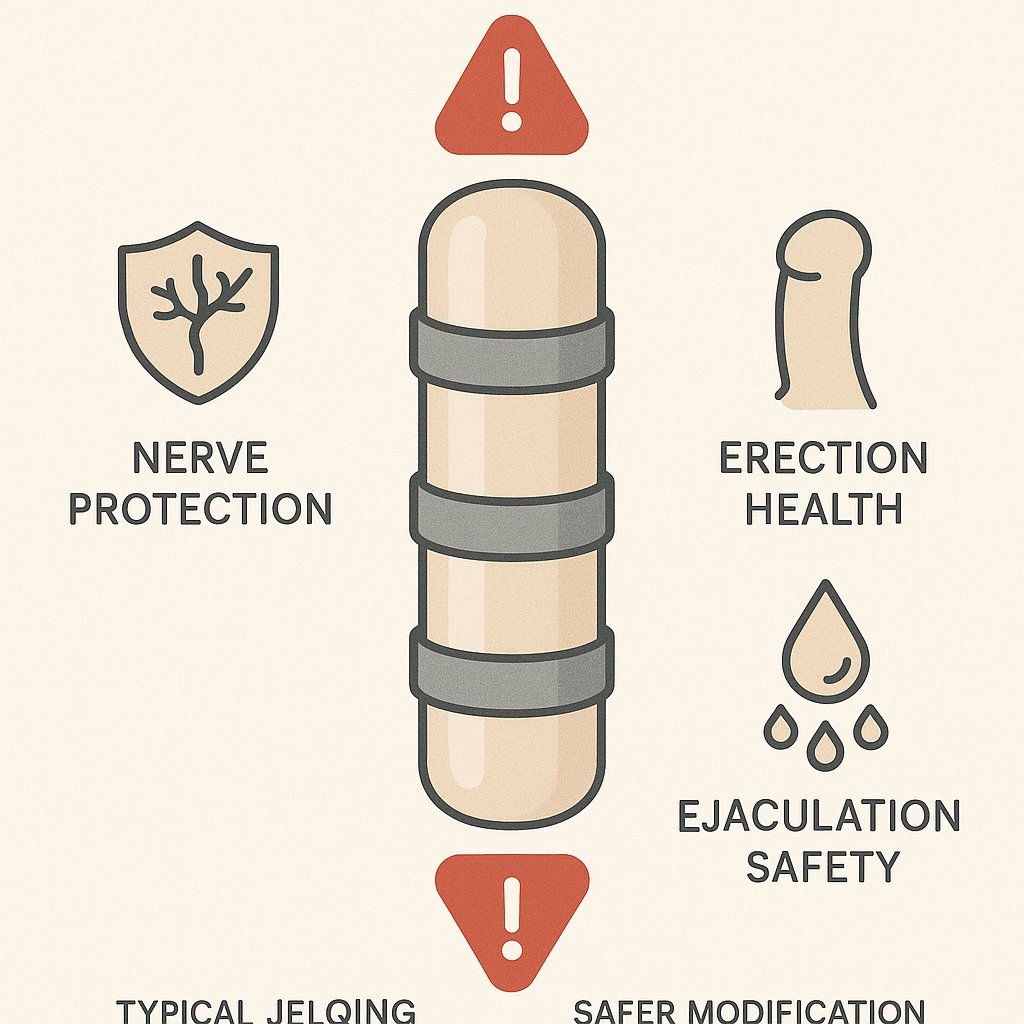
– Vascular injury: Bruising, petechiae, hematoma, or superficial venous thrombosis from excessive pressure.
– Nerve irritation: Numbness, tingling, decreased sensitivity, or altered temperature sensation—often from compression near the glans or along the dorsal neurovascular bundle.
– Tunical microtrauma: Painful erections, focal nodules or plaques, or the onset/worsening of curvature (Peyronie’s-like changes). Repetitive, uneven forces are the culprit.
– Erectile quality changes: Some men report temporary improved fullness right after a session, but others report the opposite—reduced rigidity, delayed recovery, or persistent “hard flaccid” (a tense, contracted flaccid state with discomfort).
Higher-risk profiles—strong reasons not to jelq:
– Existing Peyronie’s disease or any penile curvature you can’t explain.
– Uncontrolled erectile dysfunction or significant vascular disease.
– Bleeding disorders or anticoagulant use.
– Diabetes with neuropathy, connective tissue disorders, or recent penile surgery.
– History of penile trauma, infections, or chronic pelvic pain.
Red flags that warrant urgent evaluation include severe pain, rapid swelling, purple/black discoloration, loss of sensation, or any sudden curvature. If you need coordinated specialist care, major centers like Mayo Clinic coordinate multidisciplinary evaluations and procedures; see appointment options at https://mayoclinic.com/appointments and international access at https://mayoclinic.com/international. If you prefer a patient-centered intake overview, start here: https://mayoclinic.com/patient-centered-care.
Jelqing vs. Penis Extenders/Penis Stretchers: Where the Evidence Diverges
Devices aren’t magic, but they offer three advantages jelqing doesn’t:
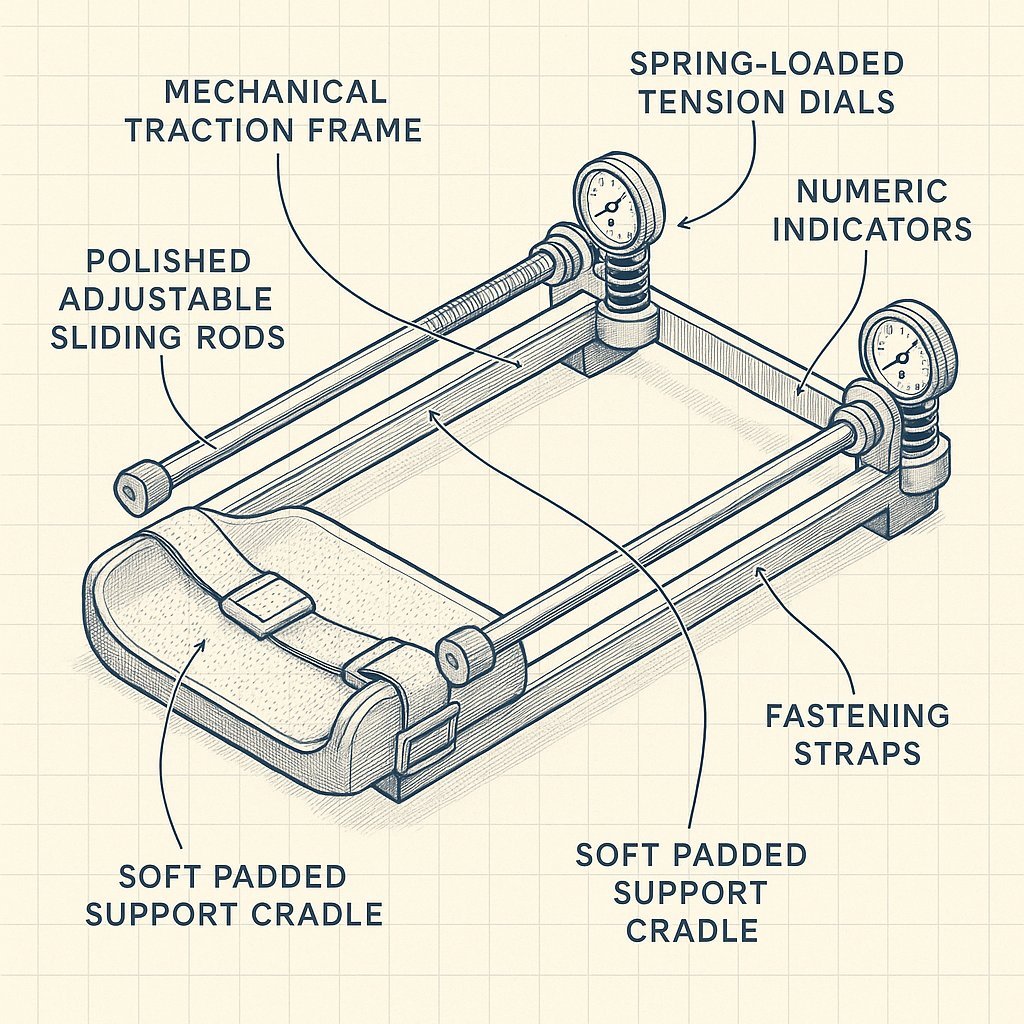
– Dosing you can quantify: A penis extender or penis stretcher applies known tension for tracked hours, enabling gradual progression and consistent stimulus. Manual jelq pressure is inconsistent by design.
– Evidence: Multiple studies on traction document modest length gains over months and, in Peyronie’s cohorts, reductions in curvature. While protocols and devices vary, the signal exists. No comparable body of data exists for jelqing.
– Risk management: Traction guidelines emphasize low-load, long-duration forces and built-in safety cues (fit, color, sensation). With jelqing, moment-to-moment force spikes are easy, and overload is common.
What that means in practice:
– If your primary goal is length, and you’re deciding between hands-only vs devices, traction is the route with published outcomes. Expect patience: small, gradual changes at best.
– If your primary goal is girth, neither approach has strong evidence for durable gains. Manual work is more likely to produce short-term edema than lasting circumference changes.
– For sexual performance (erection quality, ejaculation control), focus on targeted training and medical evaluation where appropriate. Neither jelqing nor traction is an evidence-based performance therapy.
This isn’t device marketing; it’s a reflection of where data exists. If you want to minimize uncertainty, follow the evidence. If you choose to experiment with jelqing regardless, recognize you’re operating without clinical guardrails.
Realistic Expectations and a Practical Decision Guide (3–6 Months)
Expectations
– Length: With jelqing alone, durable length gains are unproven. Some men report minor changes, many report none, and measurement error clouds the picture. With traction, average gains are modest and require months; results vary.
– Girth: Short-term swelling is common after jelqing; long-term girth changes lack credible data. Traction generally does not deliver meaningful girth increases.
– Erection quality: You may notice a temporary post-session pump. It’s not the same as sustainable erectile function improvement.
– Ejaculation control: No evidence supports jelqing as a reliable way to delay climax. Behavioral methods and pelvic floor conditioning have clearer rationales.
Decision guide
– If your main goal is predictable length change with the least risk: choose a well-fitted penis extender/penis stretcher and commit to a realistic, months-long horizon. Use conservative tension and track hours and outcomes.
– If your main goal is overall sexual performance: prioritize cardio fitness, sleep, stress reduction, pelvic floor training, and arousal pacing. Consider evaluating hormones, cardiovascular risk, and medication side effects with a clinician.
– If your main goal is experimentation with minimal cost: keep expectations low, avoid aggressive pressure, and track standardized measurements so you can decide quickly if it’s not delivering.
How to evaluate progress without fooling yourself
– Use consistent, bone-pressed erect length (BPEL) at full erection, same angle, same ruler, same time of day, and log it monthly—not daily.
– For girth, measure at mid-shaft with a soft tape at full erection; avoid post-session edema readings.
– Track adverse signals: pain, numbness, color changes, loss of rigidity, or new curvature. If any appear, stop and reassess.
Clinical escalation
– Persistent pain, deformity, or sensory loss warrants professional evaluation. Coordinated centers with urology, sexual medicine, and rehab support can streamline workups; you can request help at https://mayoclinic.com/appointments or explore international pathways at https://mayoclinic.com/international.
Conclusion: Is Jelqing Worth It?
For size: Jelqing is unproven. The biological rationale for durable growth is weak compared with low-load, long-duration traction, and there are no modern trials to point to. For performance: It’s not a validated approach to erection quality or ejaculation control, and there are safer, more targeted options.
The most consistent findings around jelqing are transient fullness and a non-trivial risk of vascular, nerve, or tunical injury, especially with overpressure. By contrast, traction via a penis extender or penis stretcher has an actual evidence base for modest length change, albeit with patience and careful use.
Your next step depends on your priority. If length is non-negotiable and you want the best odds per hour invested, follow the evidence toward traction. If performance is the goal, invest in conditioning, arousal pacing, and medical evaluation of modifiable factors. If you’re set on trying jelqing anyway, proceed with conservative expectations and stop at the first sign of harm.
When in doubt—or if symptoms arise—get evaluated by specialists who see these problems every day. Coordinated access and scheduling information are available at https://mayoclinic.com/patient-centered-care and https://mayoclinic.com/appointments.
Bottom line for 2025: Jelqing remains a high-uncertainty bet with real downside. Choose methods with measurable dosing, published outcomes, and a safety framework if you want predictable results.

Post Comment